Comparable Sales Report
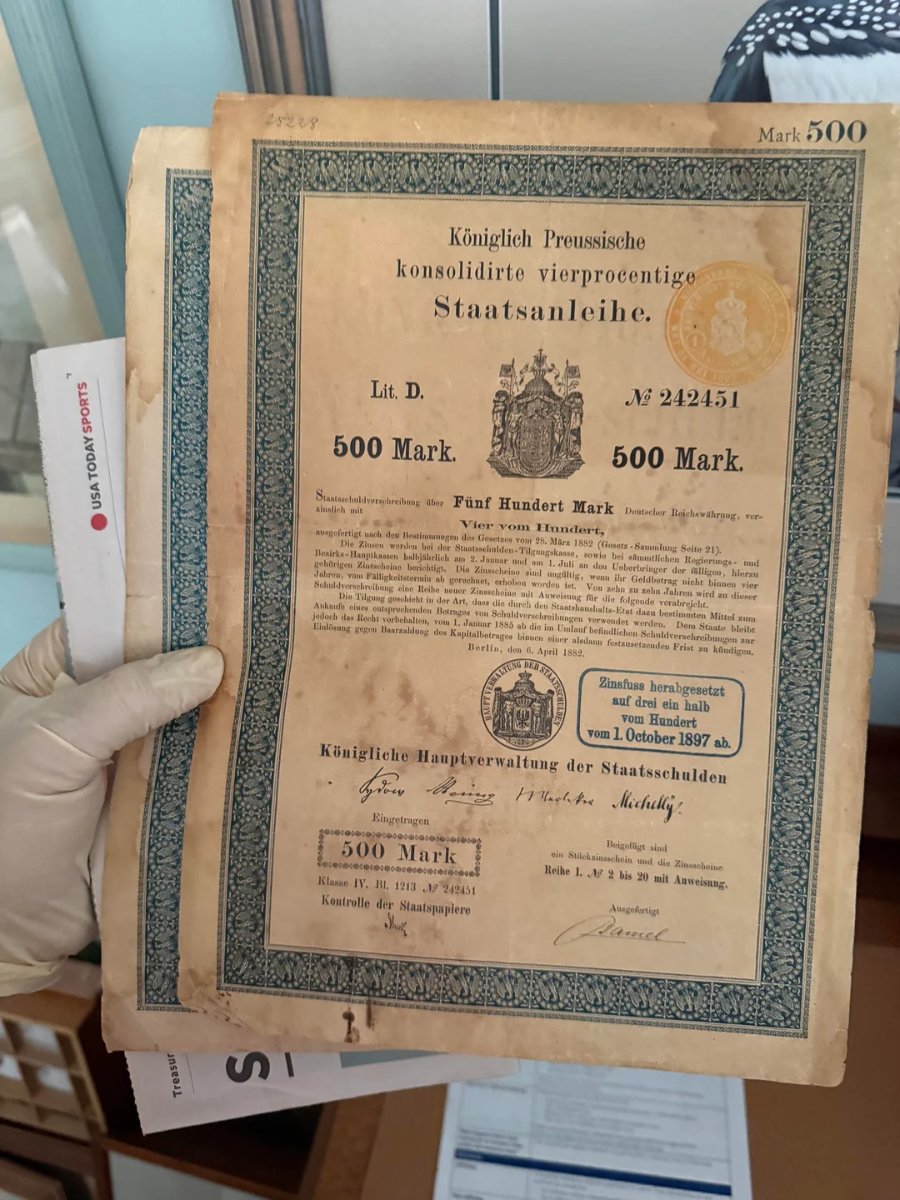
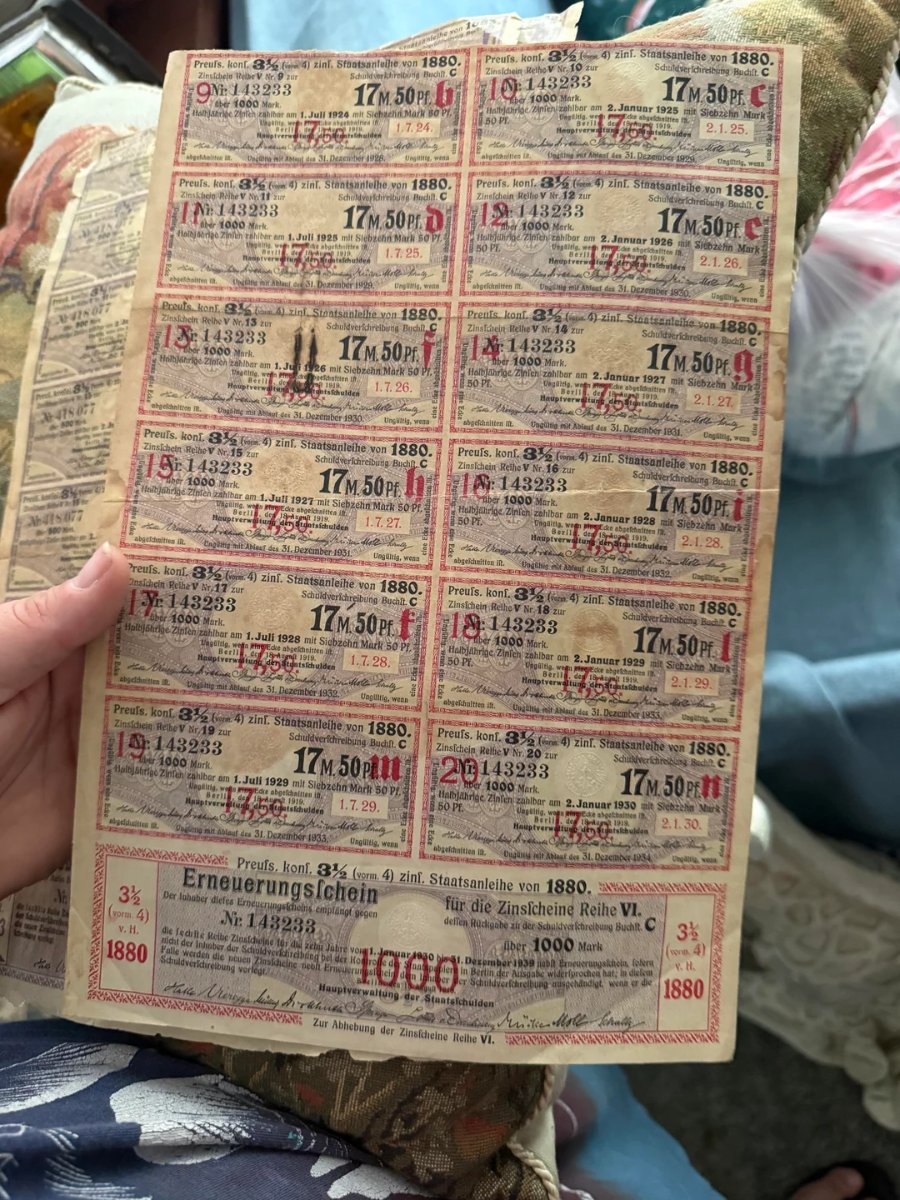
Royal Prussian 4% Consolidated State Bond, 500 Mark, 1882
Kingdom of Prussia, Berlin · Late 19th Century (Imperial Germany)
The Maker
During the late 19th century, the Kingdom of Prussia, centered in Berlin, was the driving force behind a rapidly industrializing German Empire. To finance massive state operations and infrastructure expansion under the Hohenzollern monarchy, the state issued 'Consolidated State Bonds' (Konsolidierte Staatsanleihen) by the hundreds of thousands. Initially offered at 4% in the early 1880s, these premier debt instruments were considered exceptionally stable investments.
Following the collapse of the German Empire in 1918, the subsequent hyperinflation of the Weimar Republic, and mid-20th-century settlements of German pre-war debts, these bonds were officially invalidated for financial redemption. Today, they are prized as historical artifacts within the field of scripophily. They are celebrated for their intricate security engraving, official royal coats of arms, and the physical 'coupon sheets' (talons) that investors once clipped and redeemed for gold-backed Marks.[1]
Valuation
$15 – $30
Insurance / Replacement: $60
This is an original 1882 Royal Prussian 4% Consolidated State Bond (Königlich Preussische Konsolidirte Vierprocentige Staats-Anleihe) in the 500 Mark denomination, complete with attached interest coupons. Value is anchored by consistent collector demand in the scripophily market for Imperial German securities from the late 19th century. Because these state bonds were mass-produced to fund infrastructure, they remain highly accessible; the auction range reflects peer-to-peer hammer pricing, while retail dealer replacements sit slightly higher.[1]
Market Analysis
Because direct exact-denomination sold comps for the 500 Mark 1882 issue are sparse in recent auction databases, this estimate is market-informed. Valuation logic is established by bridging adjacent denominations: 200-Mark variants from 1882 clear at auction between $3 and $22, while 1,000- and 5,000-Mark variants from the same year are sold by specialist retail dealers for $44 to $46. Since retail inventory represents a ceiling, a realistic auction hammer price for a 500 Mark certificate sits comfortably in the $15 to $30 range. Complete bonds retaining their untorn interest coupons command a slight premium over cleanly detached central certificates.[1]
Value Drivers
▲ Presence of the original, attached interest coupons (Kuponbogen/talons)
▲ Uncancelled condition, lacking the physical punch holes (lochentwertet) typical of later processed bonds
▲ Intricate late 19th-century security engraving featuring the Prussian royal coat of arms
Concerns
▼ High survival rate and massive original issuance keep secondary market supply plentiful, suppressing values
▼ Condition issues such as hard central folds, torn edges, or detached/missing coupons would push value to the low end of the bracket
🏛 Best Venue
eBay
📈 Upside Potential
Archival preservation in a graded currency slab or identification as part of a scarce sub-series block could moderately increase collector interest.
Comparable Sales (2)
George H. LaBarre Galleries ↗
2023–2024
$44.00 – $46.00
Königlich Preussische Konsolidirte Vierprocentige Staatsanleihe (1882/1890), 1,000 or 5,000 Mark variants. Includes attached coupons.
MEDIUM
SOLD
Research Details
1
Rounds
2
Verified Comps
0/0
Questions
1
References
References
Have something you're curious about?
Get your own free report →Want a report like this for your own item?
Snap a photo. Get the story, the comps, and the value — free.
Try it free →