Comparable Sales Report
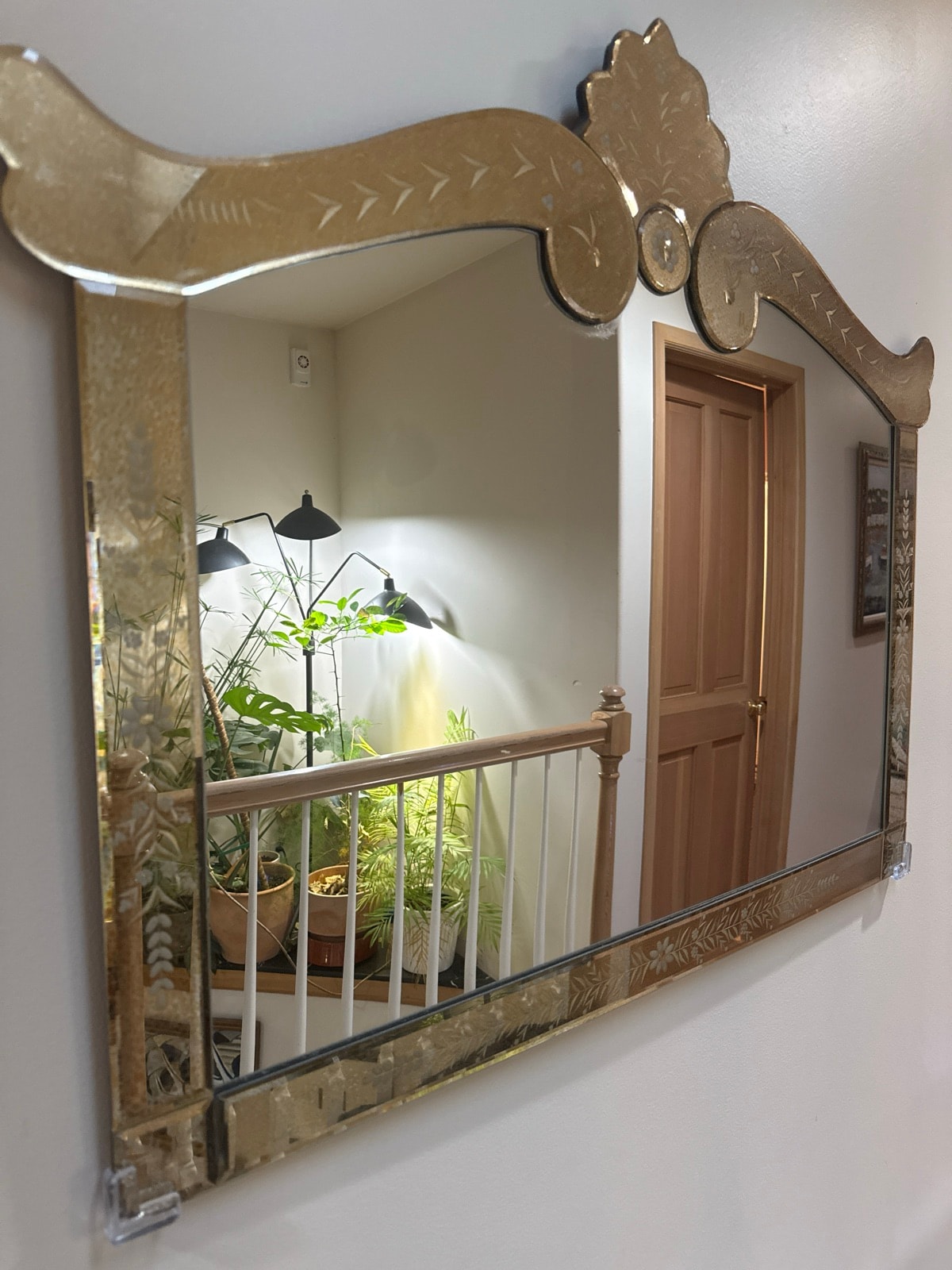
Venetian-Style Etched Glass Mirror, c. 1940s-1950s
Likely Italy (Murano) or a high-end American importer like La Barge · Mid-20th Century Hollywood Regency
The Maker
The 'Venetian style' of decorative mirror production traces its origins to the master glassmakers of 18th-century Venice, specifically the island of Murano. These artisans pioneered the complex 'glass-on-glass' technique, where the frame of the mirror is constructed entirely of intricately cut, beveled, and reverse-etched glass panels fastened with glass rosettes. Rather than serving purely functional purposes, these mirrors were conceived as grand decorative artworks designed to maximize candlelight reflection in dark palazzos. During the mid-20th century, the Hollywood Regency movement sparked a massive revival of this glamorous aesthetic in the United States. Demand for theatrical, highly reflective decorative arts led to a surge of high-quality imports from Italy. Renowned American firms, most notably La Barge, began importing exacting Venetian-style mirrors to satisfy the luxury interior design market. Because individual workshops rarely signed these pieces on the glass itself, attribution often relies on stylistic nuances, the presence of original paper verso labels, and the quality of the silvering. Mid-century examples from established Murano makers or La Barge exhibit superior hand-etching in their foliate motifs and utilize high-quality silvering that develops a characteristic, highly prized soft patina (or 'foxing') over decades.[1]
Valuation
$450 – $650
Insurance / Replacement: $1,200
This is a Mid-20th Century Hollywood Regency Venetian-style etched glass mirror, featuring an elaborate 'glass-on-glass' construction with a scalloped crest and hand-etched foliate borders. Based on the era and craftsmanship, it is attributed to the Italian Murano tradition or a high-end American importer such as La Barge. Value is anchored by the intricate application of structural mirrored panels and overall scale, which remains highly sought-after by interior designers. Because exact, identical direct comps are sparse (0/3), the valuation is market-informed, relying on proxy auction outcomes for similar unsigned mid-century examples of comparable size and condition.[1]
Market Analysis
With exact direct comps being sparse (0/3), this estimate is market-informed and relies on structurally similar mid-century proxy sales to establish a baseline. At regional fine art and furniture auctions, unsigned but authentic Venetian-style mirrors of standard scale (typically 40 to 55 inches) exhibit a tight clustering in hammer prices. Recent proxy results, such as an attributed Italian foliate mirror at Austin Auction Gallery ($500) and an unsigned proxy at Nye & Company ($600), confirm the middle market for authentic mid-century pieces. A confirmed La Barge example establishes the ceiling of this tier, recently hammering for $650 at Weschler's Auction. Lacking a definitive verso label to guarantee a specific high-tier maker, the fair market value is anchored in the unsigned proxy lane. Any structural losses, such as cracked framing panels or missing applied rosettes, would warrant significant deductions from this range.[1]
Value Drivers
▲ Complex 'glass-on-glass' construction with intricately cut, mirrored framing panels
▲ Hand-etched foliate borders and a distinctively scalloped crest
▲ Strong mid-20th century Hollywood Regency style desirability
▲ Scale (standard 40+ inch formats command auction premiums over smaller vanity pieces)
Concerns
▼ Lack of definitive maker's label or signature restricts the piece to the unsigned/attributed valuation lane
▼ High sensitivity to structural deductions (cracked framing elements severely penalize value)
▼ Vulnerability to excessive desilvering or oxidation that disrupts the visual continuity of the reflective surface
🏛 Best Venue
Specialist regional fine art and furniture auction houses (e.g., Weschler's, Freeman's) or curated secondary market platforms like Chairish.
📈 Upside Potential
Discovery of an original La Barge or specific Murano workshop label on the verso could push the piece into a premium branded pricing tier.
Comparable Sales (6)
Weschler's Auction ↗
March 2026
$650
La Barge Venetian Style Etched Glass Frame Mirror (55 x 28 inches)
MEDIUM
SOLD
Nye & Company ↗
December 2018
$600
Venetian Style Etched Glass Mirror (49.5 x 31 inches)
MEDIUM
SOLD
Italian Venetian Etched Glass Foliate Wall Mirror (55 inches high)
LOW
SOLD
Research Details
1
Rounds
6
Verified Comps
0/0
Questions
1
Context Sources
Context & Primary Sources
Discussion
Have something you're curious about?
Get your own free report →Want a report like this for your own item?
Snap a photo. Get the story, the comps, and the value — free.
Try it free →