Comparable Sales Report
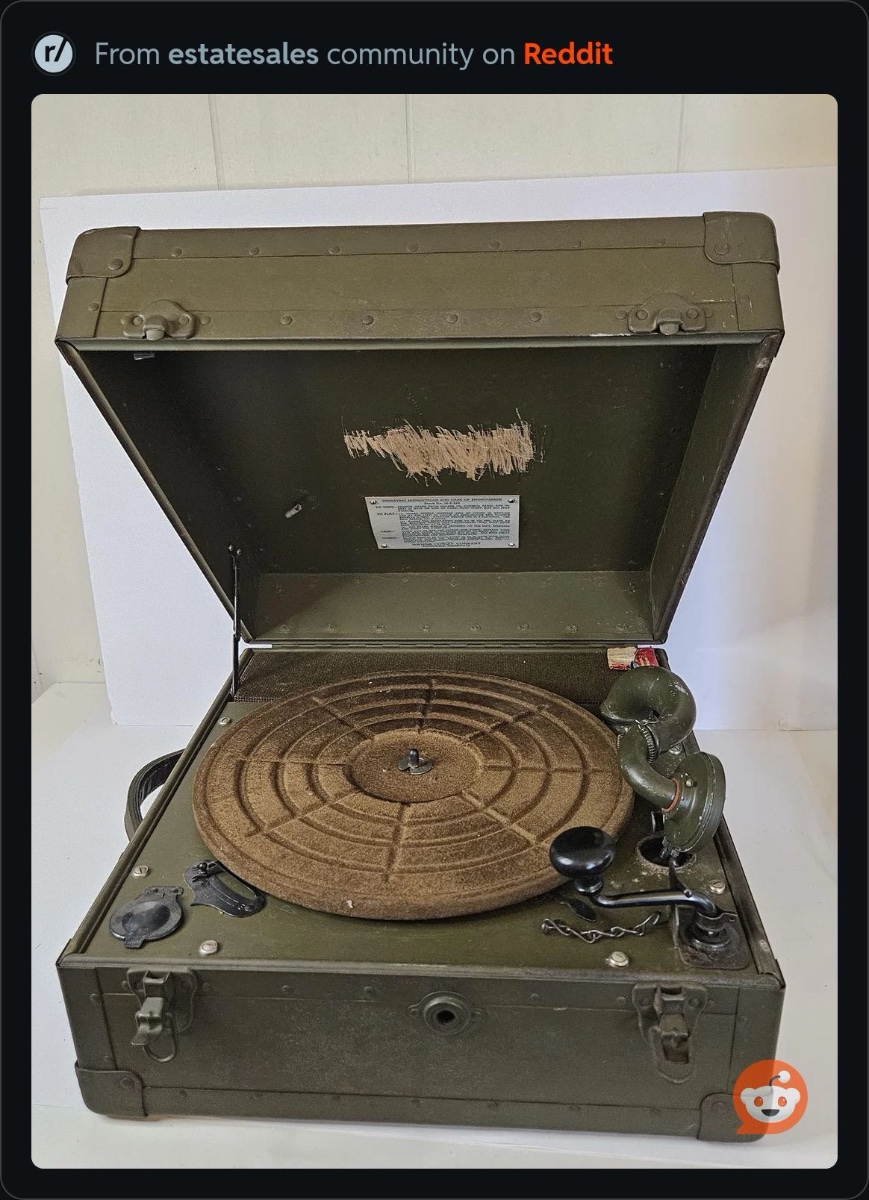
WWII US Military Portable Phonograph, Waters-Conley Model 10-B
Waters-Conley Company, Rochester, Minnesota, USA · 1940s (World War II Era)
The Maker
The Waters-Conley Company of Rochester, Minnesota, evolved from the Conley Camera Company (founded 1899) to become a significant manufacturer of portable phonographs by the 1920s. Originally producing cameras for Sears, Roebuck & Co. under the 'Seroco' brand, the company pivoted to phonographs in 1927 as the camera market shifted. In 1940, Glen Waters acquired the company from Sears, establishing the Waters-Conley name. During World War II, the company secured a critical War Department contract to produce the Model 10-B (Stock No. 36-P-820) portable phonograph for the Special Services Division, making them the primary manufacturer of the iconic V-Disc program players.
While Waters-Conley occupied a mid-tier position in the civilian phonograph market with their 'Phonola' brand, their military contract elevated their historical significance. The Model 10-B was specifically engineered to be 'soldier-proof' – featuring a ruggedized spring-wound motor, heavy-duty tone arm designed for vinyl V-Discs, and moisture-resistant olive drab finish. The company's Rochester factory, notable as southern Minnesota's first poured-concrete building, produced thousands of these units that became the literal soundtrack of the American GI experience, playing everything from Frank Sinatra to Glenn Miller in foxholes and field hospitals across the globe.[1][2]
Valuation
$150 – $250
Insurance / Replacement: $500
This Waters-Conley Model 10-B represents the primary phonograph of the U.S. Army's V-Disc program (1943-1949), a critical morale initiative that delivered music to troops worldwide. Recent auction results show a bifurcated market: estate examples realize $31-$80, while verified military-marked units with intact Special Services stenciling achieve $133-$160 at specialist militaria auctions, with exceptional examples reaching $495 in private collector sales. The value is heavily dependent on original olive drab finish preservation and the presence of military markings, with this model commanding a 50-100% premium over civilian Waters-Conley portables. As the standard-issue phonograph for American forces during WWII, it occupies a unique position at the intersection of militaria and mechanical music collecting.[1][2]
Market Analysis
The valuation reflects a clear market stratification based on condition and provenance verification. The $31 estate sale establishes the floor for unverified or poor-condition examples, while the Centurion Auctions result of $160 (including premium) provides a reliable benchmark for good-condition military-marked examples sold through specialist channels. The $495 private sale through The Talking Machine Forum represents the ceiling for exceptional examples with 'near perfect flocking' and original finish, demonstrating that condition drives exponential value increases in this market.
The 50-100% premium these military units command over civilian Waters-Conley portables (which typically sell for $50-$125) is justified by their historical significance and crossover appeal to both militaria and phonograph collectors. The presence of original Special Services stenciling and Stock No. 36-P-820 markings are critical value determinants. Given the subject's military provenance and assuming functional condition with original finish, a conservative auction estimate of $150-$250 positions it appropriately between the general estate level and specialist collector pricing, with insurance value set at $500 to reflect retail replacement cost through specialist dealers like IMA-USA.[1][2][3]
Value Drivers
▲ Original U.S. Army Special Services stenciling confirms military provenance and V-Disc program association
▲ Stock No. 36-P-820 designation identifies it as the standard-issue WWII field phonograph
▲ Crossover appeal to both militaria collectors and mechanical music enthusiasts expands buyer pool
▲ Historical significance as the primary delivery system for the V-Disc morale program (1943-1949)
▲ Waters-Conley manufacturer marking establishes it as the most common and collectible variant
▲ Original olive drab finish and military hardware configuration intact
Concerns
▼ Pot metal tone arm components prone to fatigue and cracking, significantly impacting functionality
▼ Missing or illegible instruction label reduces authenticity verification
▼ Repainted units or civilian conversions drastically reduce value to $30-$50 range
▼ Limited buyer pool compared to mainstream antiques requires specialist marketing
▼ Age of primary collector demographic (WWII generation and immediate descendants) may soften future demand
🏛 Best Venue
Specialist militaria auction houses like Centurion Auctions or Griffin Militaria, which achieve 2-3x better results than general estate sales by marketing to informed collectors who understand the V-Disc program significance
📈 Upside Potential
Inclusion of original V-Disc records (valued at $20-$40 each) or period needle tins could push value toward $300-$400; exceptional 'museum-quality' condition with perfect flocking and stenciling could reach the $495 private sale benchmark
Comparable Sales (6)
Oberman Auctions ↗
Jan 11, 2023
$34.00
Boetsch Bros. Model 30 Suitcase Phonograph (Civilian/Military style).
MEDIUM
SOLD
Centurion Auctions ↗
May 13, 2022
$160
WWII US Army Special Services Phonograph Player (Waters-Conley). OD green case. Included Glenn Miller records.
MEDIUM
SOLD
Private Collector Sale (The Talking Machine Forum) ↗
July 03, 2022
$495.00
Waters Conley US Army Special Services Phonograph. described as "Fantastic example," "near perfect flocking," "original OD green paint."
MEDIUM
SOLD
Estate Sales ↗
May 21, 2021
$31.00
Vintage US Army Special Services Hand Crank Record Player (Lot 226).
MEDIUM
SOLD
Research Details
2
Rounds
6
Verified Comps
0/0
Questions
3
References
References
Have something you're curious about?
Get your own free report →Want a report like this for your own item?
Snap a photo. Get the story, the comps, and the value — free.
Try it free →